
Love on the Final Frontier
What I Learned from the Relationships in Star Trek TNG

Life as imagined on Star Trek places at its center the adventurous explorer-scientist-officer uninhibited by relationships or domestic life. With the exception of Lwaxana Troi’s outrageous escapades to find a husband, no one is interested in marriage. Instead, the inhabitants of the Enterprise enjoy casual serial romantic encounters with one another and with others across the galaxy. No one’s feelings ever seem to get seriously hurt, and even the most remarkable connections are forgotten almost as quickly as they are forged. There are, of course, a few exceptions; relationships that leave a lasting impact on both the characters and on us, the viewers. It is in these exceptions that the series departs from its transhuman vision of relationships, revealing the truths that touch, and have always touched, the human heart.
In this two-part post, I explore the relationships of Picard and Data and what they reveal about love and authenticity.
Picard – On Love and Personal Transformation (Episodes “Lessons” and “The Inner Light”)
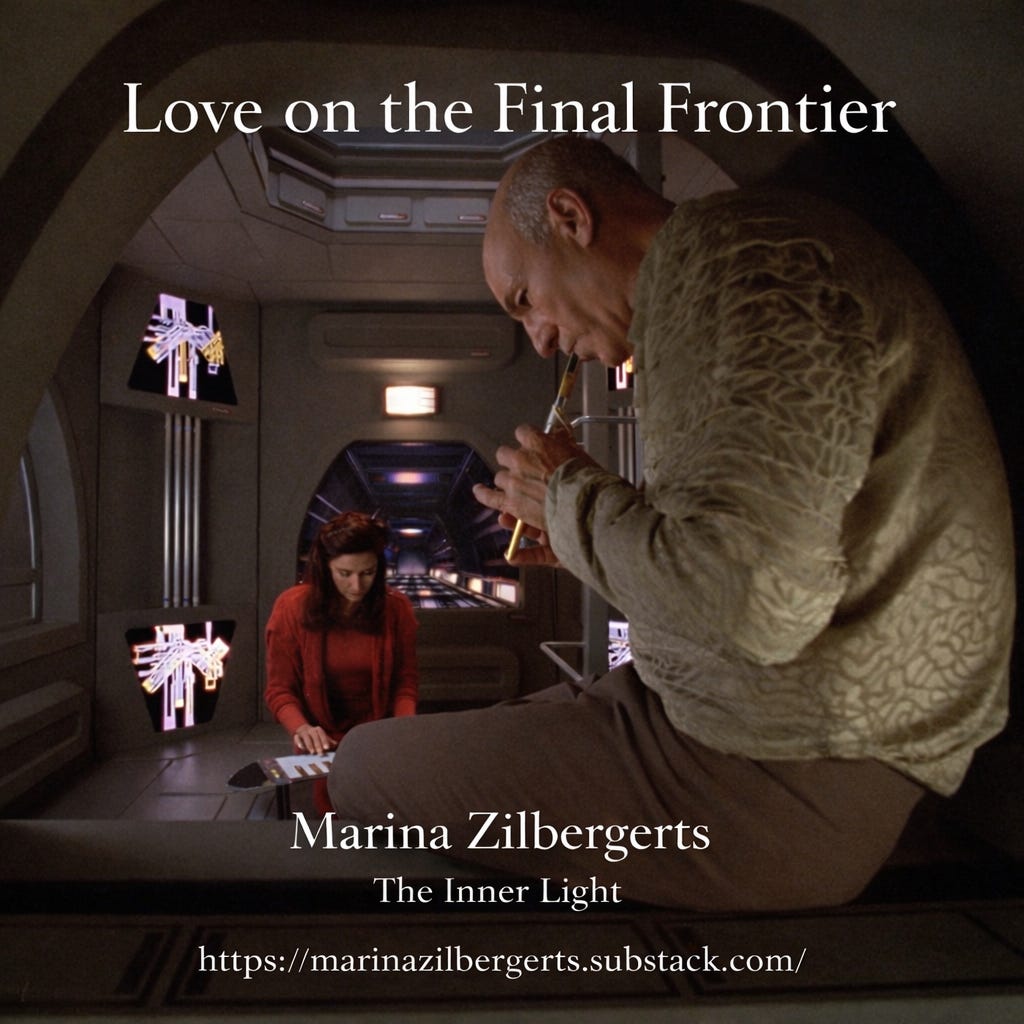
In the episode “Lessons,” Picard falls in love with the talented Lieutenant Commander Nella Daren. He is drawn to her passion for research and to the subtlety of her musical interpretations at the piano. They share moments of improvisation in which their music ascends to new heights. Holding his Ressikan flute, he shares with her the memory he guards most closely, his past life on the planet Kataan in the episode “The Inner Light.” As they play together in the most acoustically resonant space aboard the Enterprise, the viewer senses the intimacy shared between them. It is one of the most beautiful scenes in the series.
Eventually the conflict of interest gets to Picard. He sends her off on a dangerous mission and feels fear and guilt for placing her life in jeopardy. In the end, neither is willing to sacrifice their careers for the relationship, and they part ways.
I find myself regretting the loss of this connection, feeling that he gave up on it too easily. Yet I have to admit that this is entirely consistent with who Picard is. He is a character who would never willingly sacrifice his autonomy, even for love. The episode therefore invites us to return to his formative experience in The Inner Light. There, Picard does not choose family life; it is, initially, forced upon him. He awakens on Kataan to discover that his former identity, career, and future have been taken from him entirely. No matter how hard he tries, he cannot return. His only real choice is to stop resisting, to accept a life he would never have chosen freely, and a woman he likely would never have married.
Eline, his wife on Kataan, embodies a classical feminine archetype. She patiently receives his restlessness, his ambition, his attempts at escape, and even his repeated rejections. Slowly, she transforms them into opportunities for virtue and service. In their insulated life on that dying planet, there is an echo of something sacred. By the end, Picard is transformed.
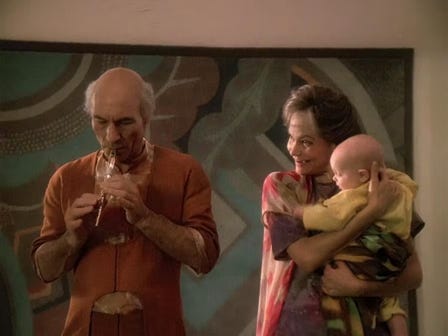
Yet, when he returns to his regular life, the experience on Kataan remains a dream, an ideal, ever present, yet nothing more than memory.
As an aside, the series takes a surprisingly traditional position in these episodes. Eline, who has no ambitions apart from having a family, leaves a permanent imprint on Picard. Meanwhile, Nella, despite her intelligence and talent, remains alone and largely forgotten by the show. This pattern extends to other strong female characters. Take K’Ehleyr for example; bold and unapologetic, she refuses the Klingon marriage vow with Worf and chooses single motherhood instead. This boldness gets her killed in a subsequent episode.
Of all Picard’s love interests, Nella is the one who could most fully understand him. Unlike the frivolous Vash, who chooses adventure with Q over him, and unlike Beverly Crusher, who can never quite reach Picard’s depth, Nella makes a compelling partner. She combines passion with restraint and independence. She unites artistic sensitivity with scientific rigor. And yet, despite their complementarity, or perhaps because of it, they choose independence over the deep transformation that such a connection could have awakened in them.
Perhaps Picard transcends the need for love. He appears so self-sufficient that he does not ultimately require it. This is partly true. But we are also drawn to consider what he does not transcend: his fear of losing autonomy, of sharing his inner world, of emotional loss of control, as evidenced by his discomfort around children. Does Picard ultimately grow? Can he transform? Or is it perhaps easier for him to remain the brave captain who saves the day than to face his own heart, or the heart of another?
In Star Trek: Generations, we glimpse Picard’s longing for a family; we see his wishful conjuring of an ideal wife and children in the Nexus. They represent a world of wholeness he both fears and desires, a world that remains beyond his reach. That wholeness emerged only when he was forced into the dreamlike world of Kataan. In the ordinary course of his life, however, he never makes the choice that would lead him toward true personal transformation.
Stay tuned for Part 2, for my analysis of Data’s relationships.
Marina Zilbergerts writes for The Inner Light | Marina Zilbergerts | Substack